
Why Should the Expansion Ratio of High-Quality EVA Slippers Be Below 1.6?
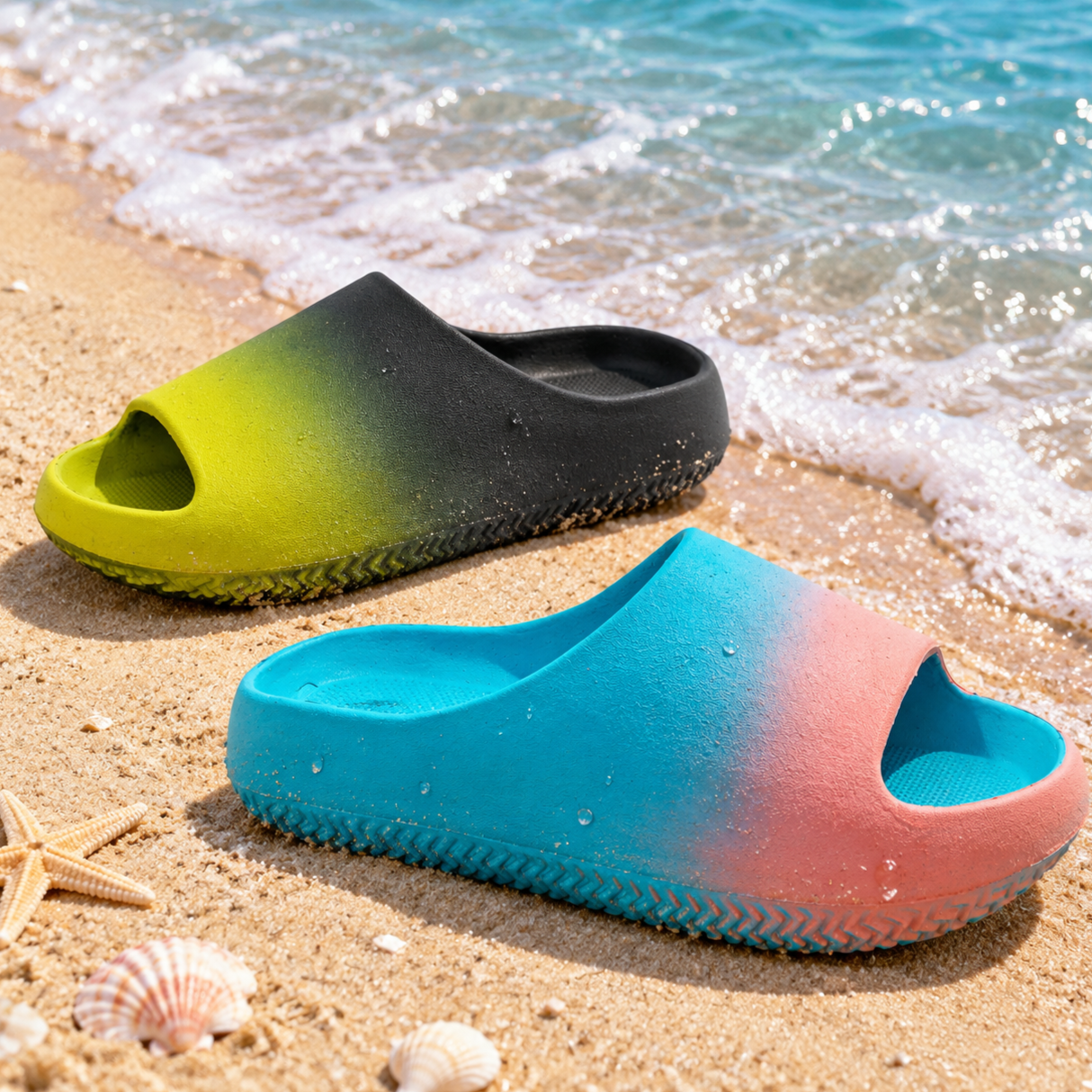
1. Why EVA Slippers Are a Smart Choice for Beachwear and Everyday Comfort
EVA (ethylene-vinyl acetate) has become a popular material in footwear manufacturing because it combines lightweight construction, flexibility, cushioning, and versatile design possibilities. For brands looking for comfortable beach sandals and everyday slippers, injection-molded EVA offers an attractive balance of functionality, appearance, and production efficiency. Compared with many traditional footwear materials, EVA can help reduce product weight while providing a soft, cushioned feel underfoot. Its low moisture absorption and easy-to-clean surface also make it suitable for beach trips, swimming pools, resort wear, and casual daily use. In addition, EVA can be molded into different shapes, textures, colors, and sole profiles, allowing footwear brands to create distinctive collections for different customer groups. These advantages make EVA slippers a practical option for retailers, wholesalers, importers, and private-label footwear brands seeking products that combine comfort with commercial appeal. However, material selection alone does not determine product quality. The formulation, foam density, molding conditions, and dimensional stability all influence the performance of finished EVA beach sandals. Research published in Polymer Testing has investigated how EVA foam density relates to compression strength and impact behavior, highlighting the importance of material engineering in footwear applications.
2. EVA Beach Sandals Trends: Lightweight Design, Comfort, and Customization
The market for beach sandals and slippers continues to offer opportunities for footwear businesses as consumers seek versatile products for holidays, outdoor activities, travel, and everyday casual wear. Lightweight slides, minimalist beach sandals, molded one-piece designs, and easy-to-wear pool slippers are useful product directions for brands developing seasonal collections. Bright colors, neutral tones, textured footbeds, sculpted silhouettes, and distinctive outsole patterns can help products stand out in online stores and retail displays. Comfort is another important consideration: buyers increasingly need products that look appealing while providing a pleasant wearing experience.
Industry research also points to continued commercial interest in EVA-based footwear. A 2026 beach-shoes market report from PW Consulting identifies EVA as a major material category and discusses flip-flops and sandals as important product segments. Such market estimates should be interpreted according to the report's methodology rather than treated as official industry statistics, but they illustrate why EVA deserves attention in product sourcing and development.
For B2B buyers, successful product development involves more than following colors or silhouettes. A reliable supplier should be able to support custom colors, private-label branding, mold development, consistent sizing, and repeatable production quality. Buyers should also consider intended use, target retail price, durability expectations, and packaging requirements when selecting an EVA slippers manufacturer. A fashionable design may attract the first purchase, but consistent quality is essential for repeat orders and long-term customer satisfaction.
3. How Injection-Molded EVA Slippers Are Made: Materials and Manufacturing
EVA stands for ethylene-vinyl acetate, a copolymer produced from ethylene and vinyl acetate. These petrochemical-derived feedstocks are combined through polymerization to create a material whose properties depend partly on its composition, particularly its vinyl acetate content. EVA is widely used in footwear because its material characteristics can be adjusted for different applications, including cushioning, flexibility, and molded components.
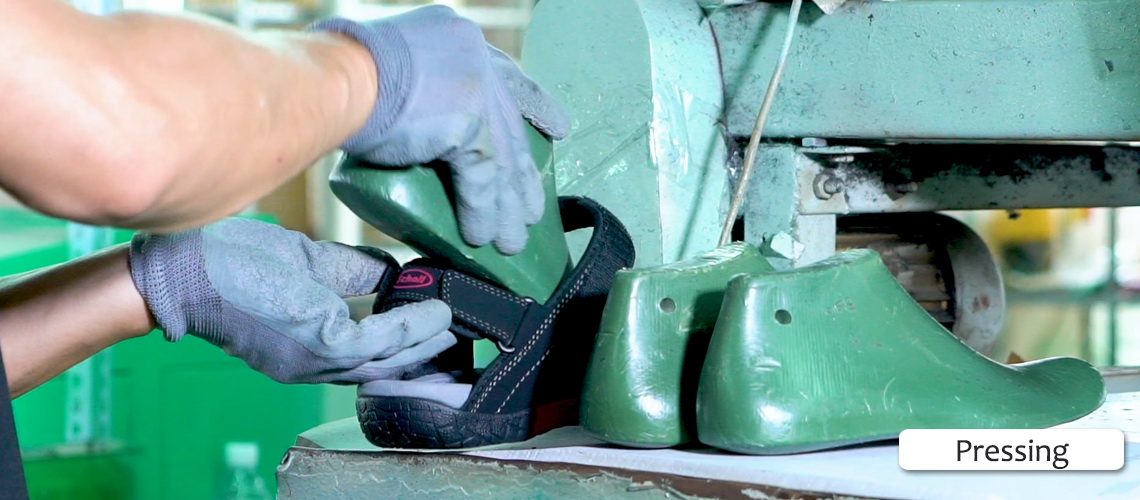
In the production of injection-molded EVA slippers, the process generally begins with a formulated EVA compound containing appropriate additives and, where required, a foaming system. The compound is prepared and processed under controlled conditions before being introduced into a mold. Heat, pressure, material flow, and foaming behavior must be managed carefully to produce the intended shape and dimensions. Depending on the formulation and production system, the material expands during processing and subsequently cools and stabilizes.
Expansion is particularly important because EVA foam does not necessarily expand uniformly in every direction. Research published in Materials Transactions examined methods for predicting EVA expansion and footwear shape, demonstrating the relationship between material expansion behavior and mold design.
After molding, manufacturers should evaluate finished products for dimensions, weight, density, hardness, flexibility, surface appearance, and resistance to repeated compression. Shrinkage and size consistency also require attention. Depending on the product specification, additional testing may assess compression set, rebound, tensile strength, and dimensional stability under heat. These checks help manufacturers identify potential problems before bulk production and reduce the risk of inconsistent products reaching customers.
For brands sourcing custom EVA beach sandals, understanding this process is valuable. A capable manufacturer must control not only the appearance of a slipper but also the interaction between material formulation, expansion, tooling, and finished-product performance.
4. Why Should the Expansion Ratio of High-Quality EVA Slippers Be Below 1.6?
The expansion ratio is an important production parameter when manufacturing foamed EVA footwear. In general, it describes how much a material expands relative to its original state, although the precise calculation can vary depending on the manufacturer's definition and measurement method. Buyers should therefore confirm whether a supplier reports a volume-based expansion ratio, a density-based ratio, or another process-specific measurement.
Why does this matter? Under comparable material formulations and processing conditions, greater expansion generally means that more volume is occupied by the foam structure and less polymer material is present per unit volume. This can reduce density and change the product's mechanical behavior. If the foam structure becomes too light or lacks sufficient structural integrity, the finished slipper may offer inadequate support, deform under repeated loading, or lose its original shape more quickly. However, expansion ratio alone cannot predict durability: formulation, cell structure, crosslinking, hardness, and processing conditions also influence the final result.
A 2005 study in Robotics and Computer-Integrated Manufacturing examined the challenges of EVA expansion during injection molding, including non-uniform expansion and the need to account for material behavior when designing molds. More recent footwear research has also investigated density, compression performance, and the mechanical characteristics of EVA foam. Together, these studies support the importance of controlling the foaming process rather than maximizing expansion without considering the intended application.
At our factory, we use an expansion-ratio target below 1.6 for our EVA slipper production. This is our manufacturing control target, not a universal international standard for all EVA footwear. Our objective is to maintain a more controlled balance between lightweight comfort, material density, structural stability, and dimensional consistency.
When expansion is excessive, the resulting density may become too low for the product's design requirements. This can increase the risk of premature compression or collapse during wear. Expansion-related dimensional changes can also complicate mold compensation and make it harder to maintain consistent finished lengths across different shoe sizes. These outcomes depend on the complete material and production system, so the appropriate limit should be verified through product-specific testing.
By keeping our production target below 1.6, we aim to achieve a more controlled foam structure and reliable sizing across our EVA beach sandals and slippers. We recommend validating these benefits through density measurements, size inspections, compression testing, and wear trials for each product specification.
For B2B buyers, this approach can help reduce quality variation, support more consistent bulk orders, and improve confidence in repeat production. Instead of choosing a supplier solely on price or appearance, buyers should ask for documented expansion-ratio definitions, density records, dimensional tolerances, and physical test results.
Partner With an EVA Slippers Manufacturer That Values Consistent Quality
Choosing the right EVA beach sandals supplier means looking beyond the initial sample. Material control, mold accuracy, production consistency, and transparent quality checks all contribute to a dependable finished product. Our EVA slipper manufacturing approach emphasizes an expansion-ratio target below 1.6, with the goal of balancing lightweight comfort with density and dimensional stability.
Whether you are developing private-label beach sandals, pool slippers, resort footwear, or a new seasonal collection, we can discuss custom designs, colors, branding, and product specifications for your market.
Looking for a reliable EVA slippers manufacturer for your next collection? Contact our team to discuss your design requirements, request samples, and evaluate the specifications needed for your target market.


Contact Us